If you’ve ever felt that commercial property is getting harder to read lately, you’re not imagining it. One month it’s “buyers are cautious”, the next it’s “competition is back”. One campaign feels quiet, the next attracts serious interest and surprisingly strong pricing. And somewhere in the middle, owners are asking the question that actually matters.
“What’s really happening in the market and what should I do next?”
Ray White Commercial’s latest research into 2025 commercial property transactions points to a market that’s not just recovering – it’s reshaping. Transaction patterns are shifting. Buyer behaviour is evolving. And in many pockets, pricing is rising in a way that rewards owners who are prepared… and punishes owners who rely on outdated assumptions.
We’re going to break down what these shifts mean in plain English and explain how to position your commercial, industrial or retail asset to win in the next 6-12 months.
2025 wasn’t “up or down” – it was different
Most people talk about the market like it’s a simple tide: rising or falling.
But 2025 was behaving more like a set of currents:
- Some sectors were drawing deeper demand
- Certain locations were seeing stronger competition
- Investor expectations were beginning to change
- And the assets that look “simple” on paper were often the ones attracting the sharpest buyers
That’s why transaction patters matter. They tell you not just what sold but what the market is rewarding and where the buyers are putting real money.
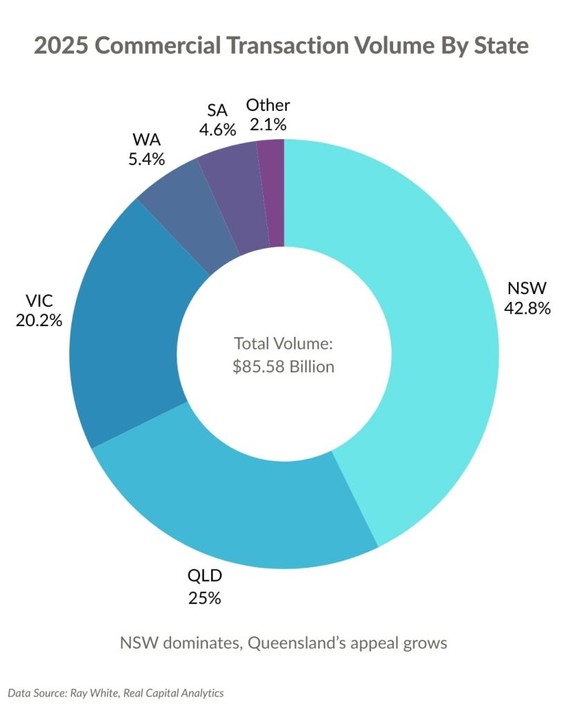
Shifting transaction patters: what’s changing behind the scenes?
1.) Buyers are more selective but they move faster on the right asset
In uncertain or transition markets, buyers don’t “stop”. They filter.
What was different in 2025 is that once a property ticks the right boxes – lease strength, location, fundamentals or repositioning potential – buyers were acting decisively. That’s one reason pricing can rise even whilst sentiment still feels cautious.
What owners should take from this:
If you’re selling or leasing, you need to present your asset in a way that makes the decision easy:
- Clear lease story
- Clean outgoings structure
- Strong documentation pack
- Transparent maintenance/compliance position
- Realistic narrative about upside (without fluff)
2.) The definition of “quality” has tightened
“Good property” used to mean a decent tenant and a decent building.
Now “good property” often means:
- Lower perceived risk
- Clear income defensibility
- Minimal surprises in outgoings and compliance
- Lease wording that supports recovery and enforcement
- Asset presentation that signals professional ownership
In other words, buyers and tenants are placing a premium on certainty.
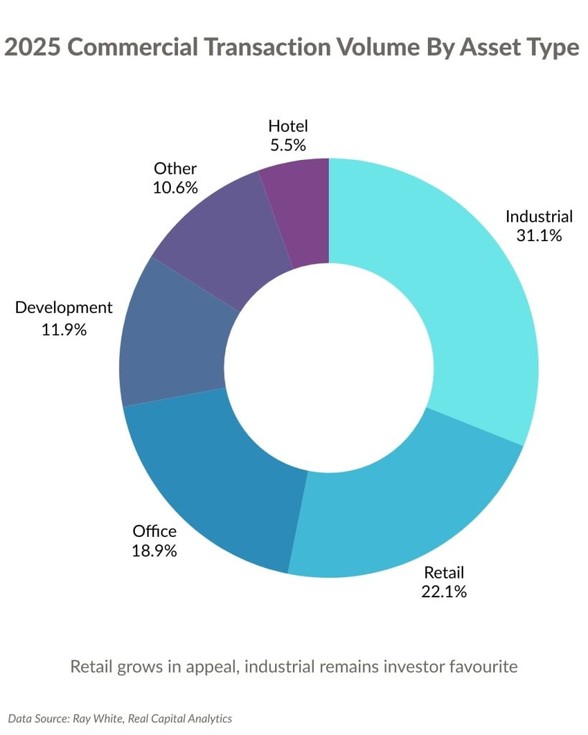
3.) Industrial keeps pulling attention but not all industrial is equal
Across Australia, industrial has attracted sustained interest for a while but 2025 has shown a more nuanced split:
- Well-located, functional industrial remains highly competitive
- Secondary stock can still perform, but pricing and demand depend heavily on useability, access and lease structure
If your industrial asset has a strong tenant and clean fundamentals, it tends to get attention quickly. If it has complications (hard access, ambiguous lease terms, messy outgoings), it still sells but the buyer will price the “unknowns” aggressively.
4.) Retail isn’t dead – it’s polarising
Retail performance is increasingly ‘asset-specific”.
Some retail assets are being rewarded when they have:
- Strong convenience positioning
- Service-based tenant mixes
- Long-term occupancy demand drivers
Other retail categories struggle if:
- Vacancy risk feels high
- The tenancy mix is fragile
- Outgoings disputes are common
- Presentation and Leasing strategy are reactive
So, in 2025, retail wasn’t one story. It was multiple stories depending on fundamentals.
5.) Buyers are reading leases harder than ever
In a rising-price environment, buyers become extremely alert to anything that could reduce net income:
- Ambiguous outgoings
- Unrecoverable management/admin costs
- incomplete CTA schedules
- Compliance responsibilities that aren’t clearly recoverable
- “100% outgoings” claims that don’t match the document reality
A buyer who finds uncertainty in the lease will do one of two things:
- Reduce price, or
- Demand contract terms that protect them
Both outcomes are avoidable when the property is managed properly and the documentation is tight.
Rising Prices: Why they’re happening (even when the mood feels mixed)
When prices rise in a market that still feels cautious, it’s usually because of scarcity + confidence in the right product.
Strong buyers don’t need the whole market to be bullish. They need:
- Stable income
- Defensible lease terms
- Asset fundamentals they understand
- And competition that confirms value
When multiple buyers want the same kind of asset, pricing rises – especially where supply is limited.
Your “net” result is being judged more aggressively
In 2025, owners were being rewarded for:
- Clean leases
- Clear outgoings recovery
- Proactive compliance
- Professional reporting
- Tenant stability and communication
- Strong presentation and maintenance planning
And they’re being penalised for:
- Vague documentation
- Reactive management
- Unresolved maintenance
- Outgoings disputes
- And leases that “sound” strong but don’t actually protect income
This is where professional commercial property management stops being a cost and becomes an advantage because it affects:
- Valuation outcomes
- Leasing outcomes
- Tenant retention
- Dispute frequency
- And how sale campaigns perform
What to do next if you own commercial, industrial or retail property
1.) Get your lease and outgoings position audit-ready
If you plan to sell in the next 12-24 months, act like you’re selling now.
That means:
- Ensure outgoings categories are correct and recoverable
- Reconcile cleanly with supporting evidence
- Tighten any “grey areas” before they become buyer objections
- Make compliance documentation easy to produce
2.) Treat presentation as pricing strategy
Even investors buying on yield respond to signal of quality ownership:
- Tidy common areas
- Clear line marking/signage
- Consistent maintenance
- Straightforward tenancy communication
Presentation isn’t “cosmetic”. It reduces perceived risk and risk pricing is real.
3.) Lease renewals are a golden window – use them strategically
Renewal time is often the only time you can realistically:
- Correct weak outgoings structures
- Clarify responsibilities
- Modernise lease clauses
- Align services with recoverability
If you miss the renewal window, you can be stuck with the same limitations for years.
4.) Align management, leasing and sales strategy (they’re not separate anymore)
Owners get the best outcomes when the same team mindset governs:
- The lease structure (management)
- The tenant quality and term (leasing)
- The income story and buyer confidence (sales)
When those parts work together, the asset becomes easier to lease, easier to manage and easier to sell – often at a stronger price.
What this means for you (and how we can help)
If 2025 showed us anything, it’s this:
The market is rewarding owners who run their properties like professional investments.
That means:
- Tight documentation
- Proactive management
- And a lease/outgoings structure that protects income in the real word, not just in conversation.
If you’d like support with commercial, industrial or retail property management (and you want your asset positioned for stronger leasing and sale outcomes), we can help by:
- Reviewing lease and outgoings structure
- Tightening recovery systems and reporting
- Reducing disputes through clearer processes
- And building an asset plan that supports valuation and buyer confidence.
