Those two words have sold more commercial properties, soothed more investor nerves, and created more avoidable income leaks than almost any other phrase in a standard Commercial Tenancy Agreement (CTA).
Because here’s the trap: in a CTA, “100%” often refers to the tenant’s contribution percentage, but it doesn’t automatically activate every outgoing category. If the relevant outgoings boxes aren’t selected, schedules aren’t completed, or the right items aren’t listed, you can end up with a lease that says “100%” at the top, while quietly excluding real, payable costs underneath.

And you only discover it when it’s too late:
- The agreement is signed
- The tenant is in place
- You’ve budgeted on assumptions
- The outgoings reconciliation hits and the tenant says, “Not payable under the CTA.”
They’re usually right.
This page is designed to help owners of commercial, industrial, and retail properties avoid that exact mistake, protect cash flow, and set up a CTA that matches what “100% outgoings” was supposed to mean in the first place.
Why this keeps happening (and why it’s so expensive)
CTAs are popular for a reason. They’re standardised, familiar, and often faster (and cheaper) to execute than a bespoke solicitor-drafted lease.
But the standard format creates a dangerous illusion:
“If it says 100%, it must be comprehensive.”
In reality, many CTAs are built like this:
- A headline statement about outgoings contribution (e.g., 100%)
- A list of outgoing categories, often with tick boxes or itemised lines that must be completed to allow recovery
- An Outgoings Definition in the Terms and Conditions which limits what Outgoings are
- Optional inclusions and Special Conditions can sometimes provide helpful support
So the CTA can say: Tenant pays 100% of outgoings… but if only a portion of the outgoings categories are actually selected or documented, then the tenant pays 100% of that portion, not 100% of everything you incur as a landlord.
That gap is where thousands leak out every year.
The most common “100% Outgoings) CTA mistake
It’s simple:
People fill out the headline and the percentage, but don’t properly complete the outgoings section underneath.
That might look like:
- Boxes left unticked because someone rushed
- Categories not selected because someone assumed “standard inclusions”
- Special Conditions not completed thoroughly because “we’ll sort it later”
In a dispute, all the above loses.
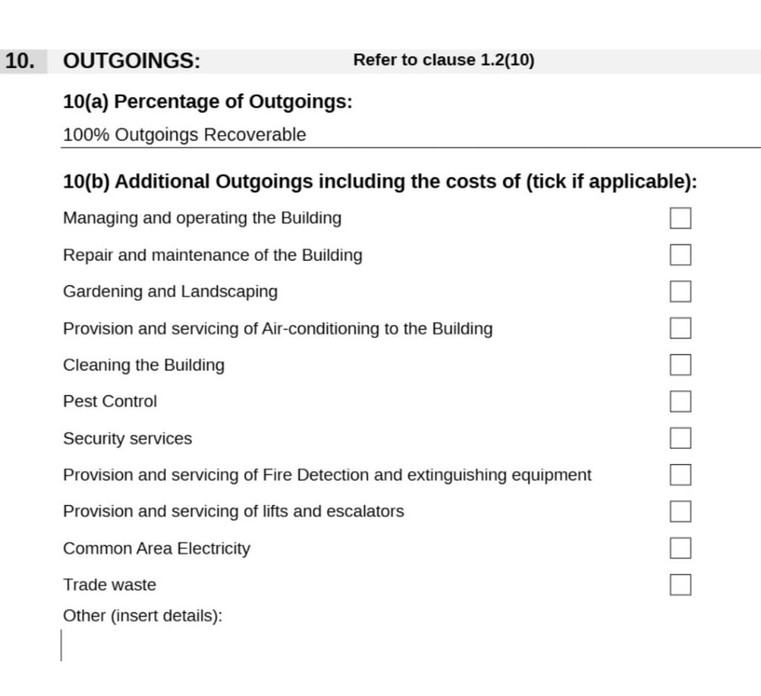
A CTA is a legal document. It only works as intended when it’s completed correctly.
What owners think “100% outgoings” includes (but often doesn’t in a CTA)
These are the costs that commonly cause friction and disappointment when the CTA outgoings section hasn’t been completed properly.
1.) Management fees
Many landlords assume property management fees can be passed through as an outgoing. In some CTAs, they’re only recoverable if specifically nominated or included under a relevant category (or a special condition).
If the box isn’t ticked, or the fee isn’t properly identified, you may wear it.
2.) Gardening and grounds care
On Multi-tenant sites, retail strips and industrial estates, grounds maintenance is often essential. But it’s also one of the most commonly missed items in a CTA outgoings list.
If it’s not selected and you do the work anyway, you may not be able to recover it.
3.) Fire compliance and admin costs
Essential services compliance is a big one. Owners often assume “fire compliance” is automatically included with other statutory costs, but CTA’s typically require you to select the correct outgoing category (or categories) to recover these costs.
Admin charges related to compliance can be even trickier if not clearly included.
4.) Cleaning, waste and common area services
Retail and multi-tenant assets often require common area cleaning, bins, pest control, security, and more. If these are not properly selected, itemised, or supported, disputes become likely.
5.) Specific-site services and contracts
If the property has site-specific needs (lift servicing, pump maintenance, air-con maintenance contracts, after-hours callouts, etc.), they often need to be clearly captured in the CTA outgoings structure.
If they’re not, your “100%” becomes a headline with a hole in it.
This is all that is recoverable under the definition of Outgoings in the Terms and Conditions.
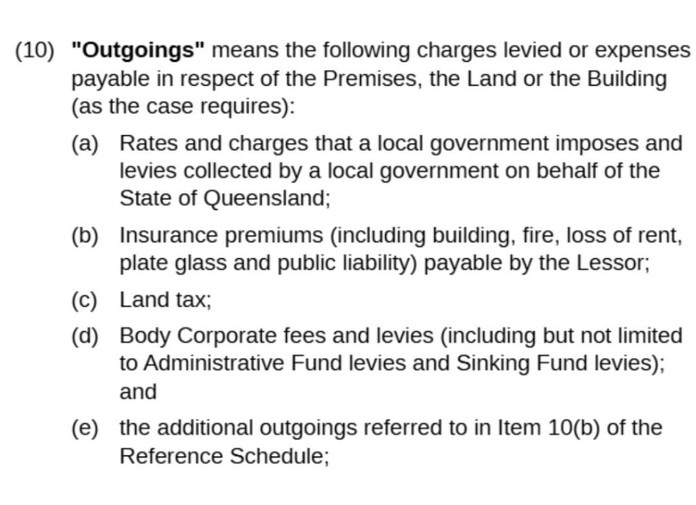
That means all you can recover is Rates etc, Insurance costs, Land Tax, Body Corporate and (here’s the kicker) the additional outgoings referred to in Item 10(b) (that’s those little checkboxes we’re about to chat about).
The moment it becomes a problem (and why it’s hard to fix)
This usually blows up at one of two times:
This usually blows up at one of two times:
When the owner hands the property to a manager
A new owner appoints management expecting “smooth sailing,” because they believe the CTA recovers everything.
Then the manager reads the CTA and has to say:
“We can’t recover those costs. The agreement doesn’t allow it.”
It’s frustrating for the owner. It’s frustrating for the manager. And the tenant is fully within their rights.
When the first outgoings reconciliation is issued
If you attempt to recover costs not properly included in the CTA:
- The tenant pushes back
- You risk a dispute
- You may have to write off those costs
- And you can damage the relationship early in the lease term
The worst part is this: once the CTA is signed, you can’t simply “correct it” without tenant agreement. And if the correction increases what they pay, why would they agree?
So the cost can run for years.
Why CTAs create this problem more than people realise
CTAs are often completed by:
- busy agents
- owners who want speed
- parties focusing on rent and term, not outgoings detail
- people who don’t deal with outgoings reconciliations every month
But the outgoings section is not admin. It’s revenue protection.
The CTA outgoings structure is like the foundation of a building:
If you miss a piece, everything built on top becomes unstable.
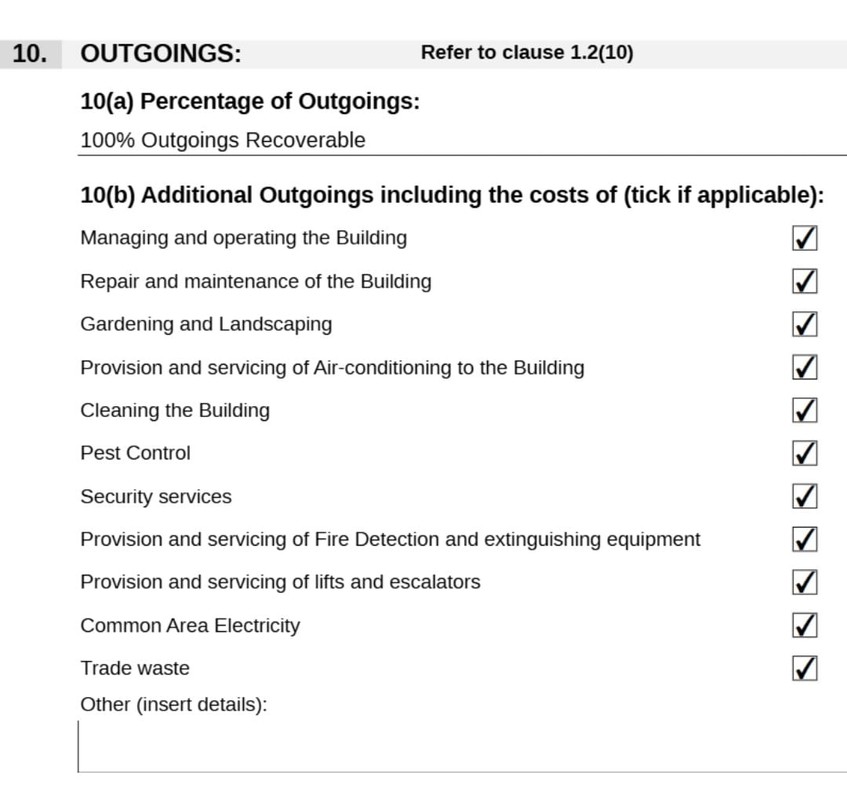
The “tick-box” reality: how a CTA decides what’s recoverable
Most CTAs separate costs into categories. The agreement then relies on one or more of the following being completed correctly:
- the outgoings categories selected (tick boxes)
- any required description fields completed
- any schedule amounts/estimates included
- any special conditions added for non-standard items
- the tenant’s contribution percentage stated (100% in this case)
If the categories aren’t selected, the tenant can argue (often successfully) that the costs fall outside “outgoings” as defined in that CTA.
That’s the heart of the issue.
The simple fix before you sign (and it’s not complicated)
Before you sign a CTA (or before you accept one as part of a purchase), have the person who will manage the asset review the outgoings section.
Not because they’re “better at legal drafting.”
Because they’re the ones who:
- reconcile outgoings
- issue budgets
- handle tenant disputes
- see the patterns of what gets missed
- know which costs show up in the real operating life of the building
A future-focused manager reads a CTA differently:
They read it through the lens of “Can I actually recover this in practice, with evidence, without conflict?”
That’s what protects income.
A manager’s CTA outgoings checklist (the stuff that stops leaks)
Here’s what I review in a CTA to prevent the “100%” mismatch:
A) Outgoings categories: are the right boxes selected?
- Statutory charges (rates, etc.)
- Insurance
- Essential services / compliance categories
- Common area or shared services (where relevant)
- Grounds and landscaping
- Cleaning/waste/security (if applicable)
- Any property-specific services
B) Are the costs clearly described and tied to the building’s reality?
If the site requires regular grounds maintenance, that must be captured.
If the building requires annual compliance, that must be captured.
If there are service contracts, they must be aligned to categories.
C) Is “management fee” recoverable under this CTA as completed?
Some CTAs handle this differently. If you intend to recover it, you need it properly included (or properly addressed via special condition wording, depending on the form).
D) Is there an outgoings budget/estimate included where required?
Even when recovery is allowed, incomplete budgeting and disclosure can create disputes later. Clarity upfront reduces friction.
E) Do the outgoings provisions align with how the property is actually operated?
A retail property is different from a single-tenant industrial shed.
A multi-tenant building is different from a standalone.
The CTA needs to reflect that reality.
What happens if your CTA is already signed and missing items?
If the CTA is already executed and you discover missing outgoings categories, there are still strategies, but they’re less perfect than getting it right upfront.
Possible paths (depending on situation and relationship) include:
- Negotiating a variation (often only achievable at renewal, or with trade-offs)
- Adjusting service levels where the lease doesn’t allow recovery (carefully, and within legal/operational obligations)
- Re-structuring certain services into tenant-paid arrangements where appropriate and permitted
- Planning a stronger outgoings structure for the next lease or renewal cycle
But none of these are as clean as: completing the CTA correctly before signing.
Why this matters across commercial, industrial and retail
Commercial
Common areas, shared services, compliance and building presentation are frequent outgoing drivers. Missing categories create constant friction.
Industrial
People assume industrial is “simple.” But once you introduce yard maintenance, security, compliance, or specialised services, you need a CTA that actually captures them.
Retail
Retail is the most sensitive to outgoings clarity. A tenant’s occupancy cost is heavily influenced by outgoings, and disputes can escalate quickly if disclosure and categories aren’t crystal clear.
In all three cases, one truth holds:
If the CTA doesn’t allow it, you don’t recover it.
Why appointing the right manager protects your income (not just your time)
Commercial property management is not just maintenance and rent collection.
Done properly, it’s about:
- protecting recoverability
- preventing disputes
- ensuring compliance is structured and documented
- keeping relationships professional and stable
- making the asset perform as intended
When I manage your commercial, industrial or retail property, I focus on the practical money-leaks first:
- Is the CTA set up properly?
- Are outgoings categories completed correctly?
- Do you have clarity on what is and isn’t recoverable?
- Is your budgeting and reconciliation defensible and clean?
Because once the paperwork is right, management becomes smoother, tenants become more predictable, and your returns become more protected.
Work with a manager who reviews the CTA before it costs you
If you’re:
- about to sign a CTA
- buying a property where the CTA is in place
- or already managing a property where “100% outgoings” isn’t matching reality
…this is exactly where I can help.
Next step
Send through your CTA (or the outgoings pages) in a free discovery meeting and we’ll identify:
- which outgoing categories are activated
- which are missing
- where the “100%” assumption may not hold
- what to fix now (or plan for at renewal)
The goal is simple: stop small oversights becoming long-term income leaks.
Disclaimer:
The information contained in this article is provided for general information purposes only and is not intended to constitute legal, financial or other professional advice. Whilst every effort has been made to ensure the content is accurate and current at the time of publication, no warranty is given as to its accuracy, completeness or suitability.
This article does not take into account your particular objectives, circumstances or needs. You should not act or refrain from acting on the basis of any content without obtaining independent, tailored advice from a qualified professional. To the maximum extent permitted by law, Ray White Commercial CSR and its officers, employees and agents disclaim all liability for any loss, damage or liability arising from reliance on, or use of, this article or its contents.
